
Table of Contents
- Why Your Morning Routine Feels So Chaotic (And How to Fix It)
- Nighttime Habits for a Better Morning
- How to Simplify Your Morning Routine Step by Step
- Morning Routine Checklist for Productivity
- Best Tools to Streamline Morning Tasks
- Neurodivergent and Parent-Friendly Morning Routine Tips
- Troubleshooting Your Morning Routine When It Stops Working
- Conclusion
Last Updated: August 25, 2026
Why Your Morning Routine Feels So Chaotic (And How to Fix It)
Most morning routines fail because they're designed wrong from the start. People pile too many steps into the first hour, then wonder why they feel frazzled before coffee. A simplified morning routine reduces decision fatigue, protects your energy, and sets a calm, intentional tone for the day. The goal isn't to do more before 9 a.m., it's to do less, better.
The core problem is usually too many tasks in too little time, or no system at all. Both create reactive mornings where you're constantly putting out fires instead of moving with purpose. According to American Psychological Association's research on stress and daily habits, unstructured mornings are a common driver of chronic stress for working adults.
Most productivity guides treat morning routines as a willpower problem. The actual fix is almost the opposite: build fewer, smarter habits, reduce friction the night before, and stop copying someone else's 5 a.m. routine when your life looks nothing like theirs.
Nighttime Habits for a Better Morning
The best morning routines are built the night before. When you reduce morning decisions, you preserve mental clarity for what actually matters.
Prep Your Space the Night Before
Spend 10-15 minutes each evening resetting your physical space. Lay out clothes, pack your bag, set up your coffee maker, clear the kitchen counter, and write down your top three priorities for tomorrow. This removes the micro-stressors that accumulate in the first 20 minutes of a typical morning.
A tidy space directly supports a stress-free morning by reducing cognitive load.
Digital Detox Before Bed
Screen time before bed disrupts your circadian rhythm and degrades sleep quality. Blue light suppresses melatonin production, making it harder to fall asleep and reach deep sleep stages.
Set a hard stop for screens 30-60 minutes before bed. Charge your phone outside the bedroom if possible. Replace scrolling with reading, stretching, or journaling. According to National Sleep Foundation's guidance on sleep hygiene, consistent pre-sleep routines that exclude screens are among the most effective interventions for improving sleep quality and morning alertness.
How to Simplify Your Morning Routine Step by Step
Simplifying comes down to three decisions: when you wake up, what you do first, and how you sequence it.

Set a Consistent Wake-Up Time
Your body's circadian rhythm regulates sleep and wake cycles. When wake-up time varies by more than 30-45 minutes day to day, that clock never synchronizes, and you spend more mornings feeling groggy regardless of sleep hours.
Pick one wake-up time and stick to it, including weekends. Start by setting your target 15 minutes earlier than your current average, not an hour. Gradual shifts are far more sustainable.
Build a Minimalist Morning with Habit Stacking
Habit stacking links a new habit to an existing one so the established behavior acts as a trigger. It's one of the most research-backed approaches to building consistent daily habits.
A minimalist morning routine might look like this:
- Wake up at a consistent time (anchor habit)
- Drink a glass of water immediately (stacked to waking)
- Splash cold water on your face or shower (stacked to drinking water)
- Get dressed in pre-selected clothes (stacked to shower)
- Eat a simple, pre-planned breakfast (stacked to getting dressed)
- Review your top three priorities for the day (stacked to breakfast)
Keep each step short and non-negotiable. Cut anything that doesn't serve your well-being or productivity.
Add Movement, Mindfulness, or Journaling
Physical movement doesn't need to be a full workout. Five to ten minutes of light exercise, stretching, or a short walk raises your heart rate and clears brain fog.
Mindfulness, even for five minutes, has a measurable effect on focus and stress levels throughout the day. Journaling works well with a three-sentence format: one thing you're grateful for, one intention for the day, and one potential obstacle.
Pick one of these three and do it consistently before adding another.
Morning Routine Checklist for Productivity
| Step | Task | Suggested Duration |
|---|---|---|
| 1 | Wake up at consistent time | - |
| 2 | Drink a full glass of water | 1 min |
| 3 | Avoid phone for first 20 minutes | - |
| 4 | Quick hygiene routine (face, teeth) | 5-10 min |
| 5 | Get dressed in pre-selected outfit | 5 min |
| 6 | Movement, stretch, or short walk | 5-10 min |
| 7 | Simple breakfast (pre-planned) | 10 min |
| 8 | Review top 3 priorities for the day | 2 min |
| 9 | Optional: mindfulness or journaling | 5 min |
This checklist is designed to fit inside 45-60 minutes. If your mornings are chaotic, start with steps 1-5 only. Add the rest once those feel automatic.
Best Tools to Simplify Morning Tasks
The right tools eliminate friction from tasks you already do, not add steps.
- Dry shampoo spray: The Hair Dry Spray Shampoo from Velora ($14.99) absorbs excess oil instantly and adds volume, saving 10-15 minutes on non-wash days.
- UV toothbrush sanitizer: A compact Germ Guard Toothbrush Sanitizer ($29.99) keeps your toothbrush clean automatically without extra effort.
- Skincare cloth: The Turmeric Kojic Cloth ($19.99) handles brightening and cleansing in one step instead of several.
- Facial hair removal spray: The Hair Identification Spray for Gentle Facial Hair Removal ($14.99) simplifies grooming without mess or time.
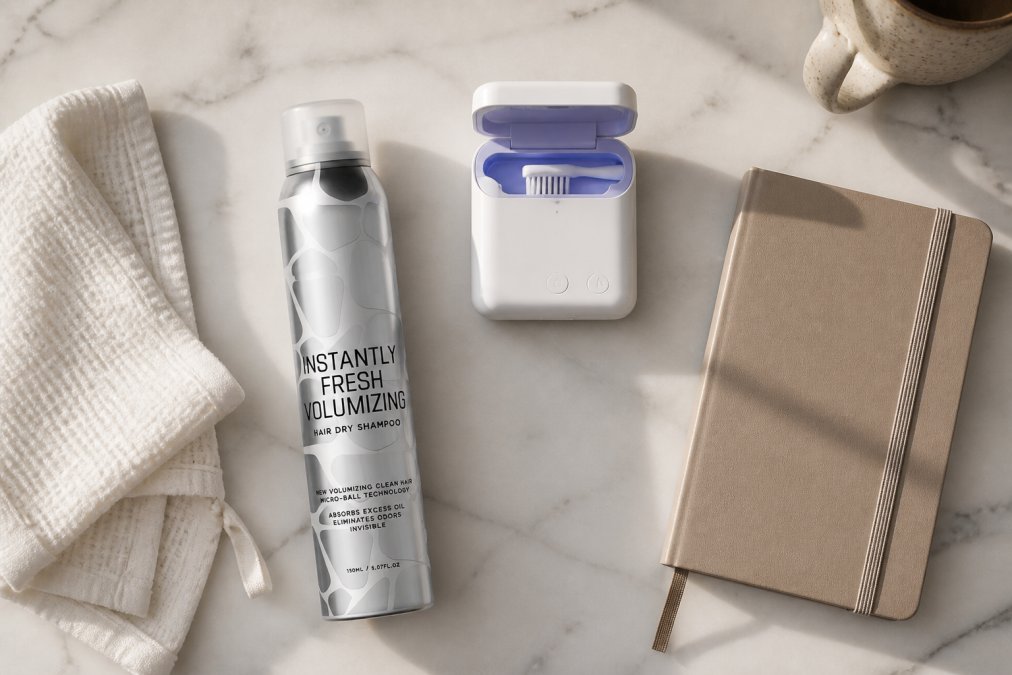
Each tool replaces a multi-step task with a single, faster one.


Neurodivergent and Parent-Friendly Morning Routine Tips
Generic advice assumes a quiet house and smooth task transitions. For people with ADHD, autism spectrum traits, or young children, adjustments make a real difference.
For neurodivergent individuals: Use visual checklists instead of mental to-do lists. Build in transition time between tasks. Reduce morning choices to near zero through pre-selection. Allow a "bare minimum" version on hard days. According to CHADD's guidance on ADHD and daily routines, structured visual routines are among the most effective tools for adults with ADHD managing daily tasks.
For parents: Shift your wake-up time 20-30 minutes earlier than your kids' for a protective buffer. Prepare children's items the night before. Batch tasks where possible. Lower expectations for school days, a five-step routine is a success.
The goal for both groups is a routine that works on hard days, not just easy ones.
Troubleshooting Your Morning Routine When It Stops Working
Every routine eventually stops working. This is normal and not a character flaw.
Problem: You're hitting snooze every day. Check your bedtime first. If you're getting fewer than seven hours consistently, adjust your sleep schedule before adjusting your alarm.
Problem: The routine feels too long and you skip steps. Cut it in half. Identify the two or three steps that genuinely move the needle and make those non-negotiable.
Problem: It works for two weeks, then falls apart. New habits require roughly 60-90 days of consistent repetition before becoming automatic. Reduce the routine to its simplest form and restart.
Problem: You feel motivated but can't seem to start. Start with one habit, not a full routine. Pick the single most impactful change and do only that for two weeks.
Problem: Your routine works on weekdays but not weekends. Keep your wake-up time within 45 minutes of your weekday time to preserve your circadian rhythm and make Monday morning easier.
Troubleshooting a failed routine is a skill, not a sign that you're not a "morning person." Most people become morning people through deliberate routine optimization over time.
Frequently Asked Questions
How do I build a simple morning routine that actually sticks?
Start with just two or three habits anchored to something you already do, like drinking water right after you wake up or doing a quick stretch before checking your phone. This habit stacking approach makes new behaviors feel automatic faster. Consistency matters more than perfection: keeping the same wake-up time every day, including weekends, reinforces your circadian rhythm and makes mornings feel less like a battle.
How can I stop feeling rushed every morning?
Most rushed mornings are caused by decisions made in the moment that should have been made the night before. Lay out your clothes, pack your bag, and prep anything you need before you go to bed. Cutting your morning decision load by even a few choices frees up mental energy and shaves real minutes off your routine. A simple morning routine checklist for productivity can also help you move through tasks without stopping to think about what comes next.
What is the 20/20/20 rule for morning productivity?
The 20/20/20 rule suggests splitting the first hour of your morning into three 20-minute blocks: movement (light exercise or stretching), reflection (journaling, meditation, or goal setting), and learning (reading or listening to something useful). It's a structured way to cover physical, mental, and intellectual well-being before the workday starts. You don't have to follow it rigidly, but the framework is a solid starting point for building a focused morning ritual.
How do I prepare the night before to simplify my morning?
Evening preparation is the single biggest factor in a stress-free morning. Lay out your outfit, prep breakfast ingredients, write a short priority list for the next day, and do a quick declutter of the spaces you'll use in the morning. Ending screen time at least 30 minutes before bed also supports better sleep quality, so you wake up with more energy and focus rather than dragging through the first hour.
Chaotic mornings rarely fix themselves. The structure has to be built deliberately, starting the night before and built around habits that actually match your life. Velora's curated selection of morning-ready products, from the Hair Dry Spray Shampoo to the Germ Guard Toothbrush Sanitizer, is designed to remove friction from the tasks you already do every day, so your routine runs faster with less effort. Shop all now and find the tools that make your mornings work for you.
This article was written using GrandRanker